Vimeo OTT in 2026: What Changed and When to Switch
Vimeo OTT after the Bending Spoons acquisition: what the platform does, what changed in 2026, who it still fits, and when native TV apps on your existing library are the better route.
Vimeo OTT is Vimeo’s subscription streaming product, the platform formerly called VHX, and it is still on sale in October 2026. Vimeo says more than 9,300 channels run on it. What changed is the company behind it: Bending Spoons bought Vimeo for $1.38 billion, closed the deal in November 2025, and in January 2026 laid off a large part of Vimeo’s staff.
This guide covers what Vimeo OTT actually does, what changed and what didn’t, who it still fits well, and when a different setup is the better choice: native TV apps built on the video library you already have, with the billing, if you have any, staying on your side. We build that second option at Tappla, so read the comparison with that in mind. We have tried to be fair about where Vimeo OTT is the right answer.
What Vimeo OTT is
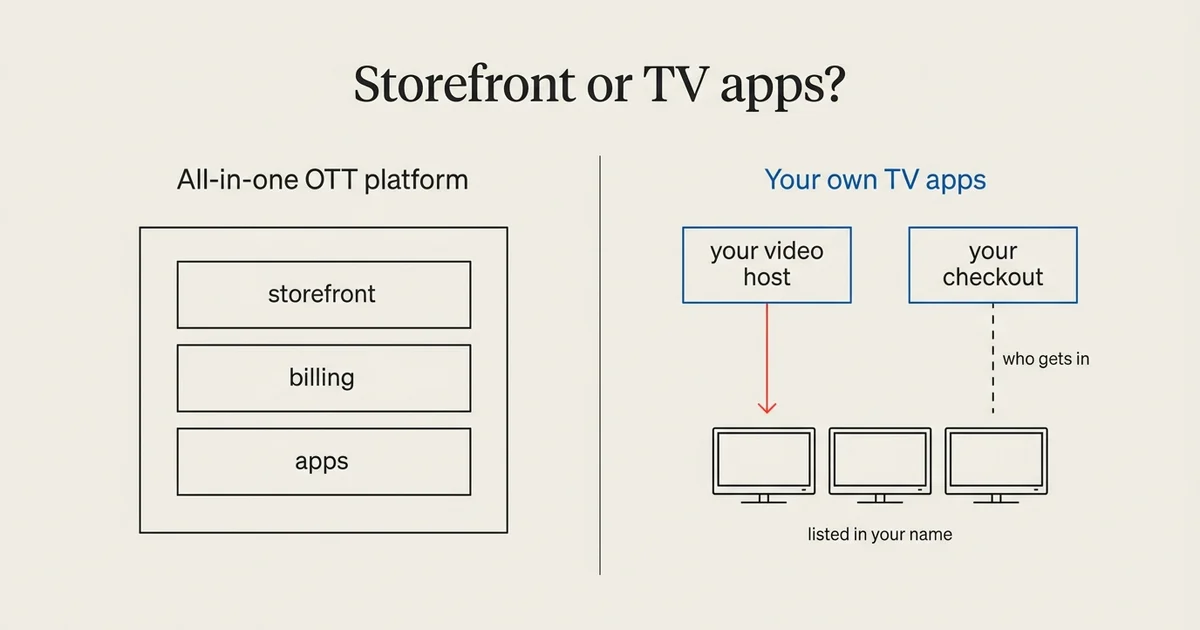
Vimeo OTT turns a video library into a complete streaming service: a website storefront, apps, a subscriber database and the payment flow, all run by Vimeo. You upload your catalog, set prices, and Vimeo sells access on your behalf.
The monetization models
Vimeo lists four models on its OTT page: subscription video (SVOD), pay-per-title (TVOD), ad-supported (AVOD) and free (FVOD). The core of the product is the first one. A viewer pays a monthly fee, and Vimeo handles the checkout, the renewals and the access across web and apps.
The platforms
Vimeo OTT advertises apps for iOS, Android, Apple TV, Android TV, Roku, Amazon Fire TV, Samsung Tizen, LG, Vizio and Xbox, plus the web storefront. That is a wider device list than most TV app builders cover, including ours.
How it is priced
Vimeo describes the pricing as pay-as-you-go: the cost scales with the number of subscribers, and larger setups are quoted individually. The model only makes sense if you sell subscriptions, because what you pay is tied to how many people pay you.
What changed in 2025 and 2026
The acquisition
Vimeo announced on September 10, 2025 that Bending Spoons would acquire it for $1.38 billion in cash. Bending Spoons is the Milan-based company that owns Evernote and WeTransfer. The deal closed in November 2025, and Vimeo’s new lead from Bending Spoons published a look ahead on the Vimeo blog shortly after.
The layoffs
On January 20, 2026, Vimeo laid off a large share of its employees. Bending Spoons confirmed the layoff to Gizmodo, which reported, citing former staff, that the cuts included the video team. Bending Spoons did not give numbers.
What it means for an OTT channel
Nothing has been shut down. The OTT page is live, the storefronts work, and Vimeo still takes new customers. The honest description is uncertainty, not collapse: a product that depends on a small number of people at a company that has just reduced them. Bending Spoons’ earlier acquisitions, WeTransfer and Evernote, saw price and plan changes after the purchase, and Vimeo’s own standard plans were already restructured before the deal.
If your channel runs on Vimeo OTT and works, there is no emergency. There is a reason to know what your options are before you need them.
Who Vimeo OTT still fits
Be honest about the job before you compare tools.
You are selling subscriptions as the business
If your channel is the product, a fitness library, a film catalog, a comedy subscription, then the storefront, the dunning, the trial logic and the churn reports are the work. Vimeo OTT does all of that in one place. A TV app builder does not replace it.
You need every device, including phones and smart TVs
If your audience watches on phones, the web, Samsung and LG sets and Xbox, Vimeo OTT covers all of them. Tappla builds for the four living-room platforms: Apple TV, Roku, Fire TV and Android TV.
When your own TV apps fit better
Many organizations on an OTT platform are not selling subscriptions at all, or sell them somewhere else already.
Your audience already exists
A church, a city channel, a sports league or a membership organization does not need a storefront to find viewers. It needs to be on the living-room TV under its own name. If that is the job, the storefront is cost without benefit.
Your billing already runs somewhere
If members pay you through your website, your membership software or your donation platform, moving that into an OTT platform means moving your customer relationship too. With your own TV apps, the billing stays where it is, and the TV app only needs to know who is allowed in.
You want the listing in your name
Tappla builds the apps, and you publish them through your own Apple, Roku, Amazon and Google developer accounts. The listing, the reviews and the installs belong to your organization, and they stay where they are if you ever leave Tappla.
You want a flat price
A per-subscriber price rises as your audience grows. A builder charges for the apps, not for the people watching them.
Vimeo OTT vs. your own TV apps at a glance
| Vimeo OTT | Native TV apps on your library (Tappla) | |
|---|---|---|
| What it is | Complete subscription streaming service | Native TV apps on the video you already host |
| Payments | Vimeo runs checkout and renewals | Stay on your side; Tappla processes no payments |
| Members-only content | Through Vimeo’s subscriber accounts | Access codes or your own site unlocks the TV |
| Devices | Web, mobile, TV, game console | Apple TV, Roku, Fire TV, Android TV |
| Store listing | Set up through Vimeo | Your own developer accounts |
| Pricing | Scales with subscribers | Flat monthly price per plan |
| Where the video lives | In Vimeo OTT | Wherever it is now: Vimeo, Bunny Stream, a live stream, a JSON feed |
Members-only content without a storefront
The part people expect to lose when they leave an OTT platform is the gate: some videos for everyone, some only for members.
Access codes
In Tappla you mark a playlist as members only and create access codes. Whoever should get in gets a code: by email after a purchase, on a membership card, read out on air. The TV shows a short code, the viewer enters both on their phone, and the TV unlocks. No password typed with a remote.
Your own site as the gate
If your website already knows who your members are, it can unlock the TV directly through the partner API, without anyone typing a code. Tappla receives an opaque reference you choose, never the member’s name or what they paid.
Where it works today
The members-only lock works in the Apple TV, Roku, Fire TV and Android TV apps.
Moving from Vimeo OTT to your own TV apps
Step 1: decide where the video lives
Tappla reads from a video host rather than storing your files. If you already have a regular Vimeo account on the Standard plan or higher, that works directly; see how Vimeo videos get onto Roku, Apple TV and Fire TV. Otherwise compare hosts in our guide to the best video hosting for a TV app; Bunny Stream is the low-cost option.
Step 2: export from Vimeo OTT
Download your source files and export your subscriber list while you still have full access. The subscriber list matters even if you never sell through Tappla: it is how you tell your audience where to find the new apps.
Step 3: connect and brand
Connect the host in Tappla, set logo, colors and layout, and mark the members-only playlists.
Step 4: publish and run both in parallel
We build and sign the apps, you publish them under your own accounts, and you keep the old channel running until your viewers have moved. A month in parallel is a sensible minimum.
What it costs
Tappla is a flat monthly price: one native app (Roku, Fire TV or Android TV) is $49 per month, and all platforms including Apple TV are $149 per month. Developer accounts are paid to the platforms directly: Apple $99 per year, Google Play $25 once, Roku and Amazon free. Your video host is billed separately by the host. See pricing for details.
Summing it up
Vimeo OTT is still a complete answer if selling subscriptions is your business and you need every device. Its ownership changed, its team got smaller, and that is a reason to know your options rather than to panic. If your audience already exists and your billing already runs somewhere, native TV apps on your own library do the TV part of the job, with the listings in your name. Our OTT app development page covers how that works across all four platforms.
Frequently asked questions
Is Vimeo OTT shutting down?
No shutdown has been announced. As of October 2026, Vimeo still sells Vimeo OTT and existing channels keep working. What changed is the ownership: Bending Spoons acquired Vimeo in November 2025 and laid off a large part of the staff in January 2026.
What is the difference between Vimeo and Vimeo OTT?
Regular Vimeo is video hosting: you upload, embed and share. Vimeo OTT is a subscription streaming service built on top, with a storefront, subscriber accounts, payments and apps. A TV app builder like Tappla can read a regular Vimeo library on the Standard plan or higher.
What is a good Vimeo OTT alternative?
It depends on the job. If you sell subscriptions as your business, look for another all-in-one subscription platform. If you mainly need your existing audience on the TV, a native TV app builder on your current video host is simpler and usually cheaper, because you are not paying for a storefront you don’t use.
Can I keep members-only content without Vimeo OTT?
Yes. Tappla lets you mark playlists as members only and unlock TVs with access codes or through your own website. Your billing, if you charge, stays on your side.
Does Tappla take a share of my revenue?
No. Tappla charges a flat monthly price for the apps and does not process payments, so there is nothing to take a share of.
Which devices does Tappla cover?
Apple TV, Roku, Amazon Fire TV and Android TV, including Google TV devices. Tappla does not build phone apps or Samsung, LG or Xbox apps.
Do I have to move my videos off Vimeo?
Not if you have a regular Vimeo account on Standard or higher. Tappla reads that library directly. Videos that only exist inside Vimeo OTT need to be exported and hosted somewhere Tappla can read, such as Vimeo or Bunny Stream.
How long does a move take?
Connecting a host and branding the apps takes a day or two. Store review adds a few days per platform. Plan for running the old channel in parallel for about a month while your viewers switch.
Put your channel on the TV — in days.
Connect the video source you already run and ship native apps under your own accounts. From $49/month.